
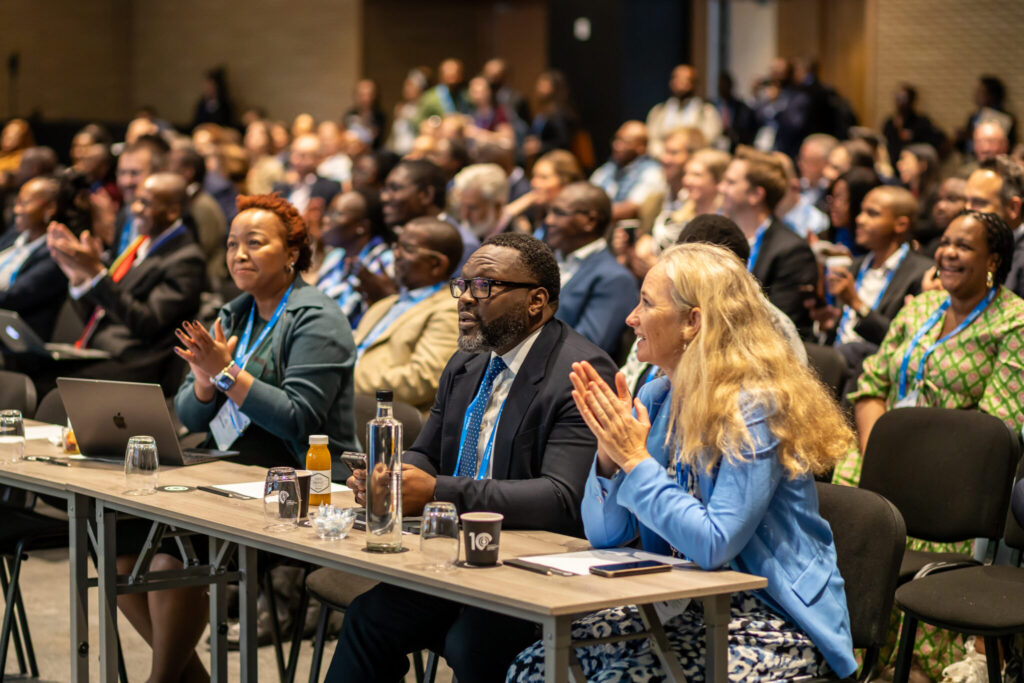
“Let’s stop being poets talking about bringing climate finance to the continent. Let’s be plumbers and do the work. Let’s work with entrepreneurs, nurture them, ensure that their business propositions are investment-ready and invest in our African green and blue entrepreneurs, because the time is now for Africa,” said Matsi Modise, Africa Lead at the World Climate Foundation (WCF), in a keynote address at Africa’s Green Economy Summit in Cape Town on Wednesday.
The theme of the opening session was: “From Ambition to Action: Scaling Investment in Africa’s Green and Blue Solutions.” This is the fourth edition of the summit that connects investors, innovators, policymakers and scientists with the aim of unlocking green finance and accelerating sustainable development across the continent in the energy, transport, water, agriculture, waste, green buildings, blue economy and clean tech sectors.
In addition, more than 50 investment-ready projects are featured across two dedicated pitch stages, from early-stage to large-scale infrastructure.
Working hard for investments
The CEO of Sanlam Investments, Carl Roothman, reminded the audience that it is not Africa’s right to get investments: “We have to work incredibly hard for these investments. We’re competing with Asia, with Eastern Europe. But the opportunity, if we do it right and channel the money and go from ambition to action, we can leapfrog what is happening in the rest of the world, with all of the resources we have in Africa.”
He added: “When you think about Africa, we think of ourselves as one continent. But to the policymakers, the regulators, I say—make it as simple as possible, go for the investment.”
The South African Deputy Minister of Forestry, Fisheries and Environment, Narend Singh, shared that South Africa was “one of five countries in Africa with a Climate Change Act. The challenge now is implementation. To achieve realistic action, a plethora of actions need to be addressed.” These include “creating the ecosystem for entrepreneurs and small businesses, who are the disruptors, to be able to realise an inclusive low-carbon economy.”
Just transition a priority
Geopolitical change, extreme weather and youth unemployment are reshaping the policy landscape, said Harsen Nyambe, Director for Sustainable Environment and Blue Economy at the African Union Commission, the official host organisation of AGES.
Despite challenges ranging from climate impacts to regional conflict, he argued AGES provided a platform to connect investors with innovators and move “ambitions into implementation.” While global discussions often focus on net-zero targets, Africa’s priority is a just transition, he said, using its natural resources to leapfrog development while creating green jobs.
The continent’s critical minerals endowment places it at the centre of e-mobility and low-carbon industries, while biodiversity, water and sanitation sectors could also attract investment. The African Union is supporting member states to prepare climate-finance pipelines through its Green Recovery Action Plan.
“We are not here to seek charity,” Nyambe continued, “we are here to share global solutions for business and humanity.”
“Just get it done”
From the investor perspective, Andrew Johnstone, Chief Executive of Climate Fund Managers, defined the green economy as behaviour change towards low-carbon, climate-resilient and resource-efficient growth. Unlike industrialised economies that must decarbonise existing systems, Africa has an opportunity to avoid locking in carbon-intensive development, he said.
The continent’s infrastructure deficit, renewable resources and population growth create significant investment potential in water systems, hydrogen, industry and technology.
Crucially, he added, global capital is available, but flows to scalable, risk-adjusted opportunities. “Money flows where risk exists, because with risk comes return,” he said, urging faster project preparation and execution. “No more speeches… just get it done.”
Not about quantity, but quality
As climate ambition rises across Africa, the focus is shifting to implementation. Several AGES sessions on Wednesday put the spotlight on important financial and development actors in the sector, including national green funds, development banks and sovereign platforms that use their own balance sheets to move green projects from ambition to execution.
“If we want to really have a transformation of our world, then we need to ensure that money flows where the needs are highest,” said Barbara Buchner, Global Managing Director at Climate Policy Initiative. “Our work at CPI shows that overall climate finance globally has been increasing quite a bit, but only 3–4% currently goes to Africa. So there is a huge gap, even though we have seen increases over the last years, including from private investors, but that gap really defines the opportunity on the continent here.”
She added: “To me, what matters most is that it’s not only about scaling investment and it’s not only about the quantity, but it is about quality. That every dollar needs to have a bigger impact and needs to be used most effectively.”
Putting “plumbing” in place
The session moderator, Aakif Merchant, Director and Head of Africa at Convergence, was one of several speakers on the AGES stage who liked and repeated the “poet and plumber” analogy introduced earlier by the WCF’s Matsi Modise.
He explained: “We really need to put the plumbing and the architecture in place in order to mobilise private capital. You’ve got amazing businesses and entrepreneurial energy in Africa. You’ve got the capital here. What we need to do is intermediate between the demand and the supply. And that’s a function of putting the pipes and the plumbing and the architecture and the systems in place. So that’s what we really need to align our focus and our time and energy.”
Powering resilient agriculture
Proving again that AGES showcases best practices and success stories on the ground, during a discussion on renewable energy solutions in the agriculture sector, the so-called “godfather of hydropower in South Africa,” sector pioneer Ian de Jager of I&F Engineering, was an audience favourite.
He is trusted by many large-scale farmers to develop hydropower systems on their farms. He jokingly described farmers as “a totally different breed of species,” adding that, “farmers don’t want information, they just want the answer.”
Join Africa Green Economy Summit 2027 and be in the room where finance meets impact.
Pingback: acular ketorolac indications
Pingback: ivermectin for parasitic worms
Pingback: vardenafil 10 mg summary
Pingback: bronchitis complications