

A new dawn for African carbon markets?

The proverbial dust has not settled on COP29’s agreement on carbon markets, with many questions lingering. The agreement should help countries deliver their climate plans faster and more cost-effectively, and therefore support the progress in reducing global emissions. Several previous COPs were unable to achieve such an agreement. While some critics call COP29’s rubberstamping of Article 6 rushed, other carbon market experts have urged caution over what the decision means for long-running efforts to turn the UN carbon market into a reality, as several key building blocks still need to be agreed on before credits can be traded.

Voluntary carbon markets (VCMs) are marketplaces in which buyers voluntarily purchase and trade in offsets generated from emissions reduction or removal projects and have long been the subject of divisive discussions and debates. Those in favour state that such markets enable companies and other buyers to purchase carbon credits to offset their emissions, that they are essential to increase climate finance and enable companies to reach their net-zero targets. With some analysts estimating a market size of $250 billion by 2050, many developing countries have announced ambitious plans to use credit revenues generated from domestic forests to boost their economies.

However, critics have argued that voluntary agreements are little more than so-called “greenwashing” or “climate washing,” claims that have proven true in certain cases, with trading in credits declining during 2023 and companies growing increasingly concerned over potential reputational risks.

System underprepared

Especially VCMs have experienced several problems and issues of accountability. This includes project developers exaggerating the climate benefits of their initiatives, leading to a drop in demand and collapse in prices. Other challenges include the loss of funds due to administrative costs and intermediary profits that benefit project developers and intermediaries in the Global North. In addition, carbon credit projects may displace local communities in the Global South from their land.

In addition, there is a clear need for globally accepted standards and accredited mechanisms to assist in developing (especially bespoke) deals, avoiding “phantom” credits that do not represent genuine carbon reductions and keeping scammers out. “Bad actors and cowboys and crooks,” is what Go Green Africa’s Iain Banner calls them, people “who saw an opportunity in the early days to take full advantage of a system that was perhaps underprepared for that attack.” [See full interview here.]

African VCM market

“When you look at the very positive messaging that came out of COP29 around some level of conclusions being reached around Article 6.4, we feel these have introduced much needed clarity on internationally traded mitigation option trading rules as well as authorisation pathways and ultimately cooperative approaches to the building of Article 6 markets,” says Paul Muthaura, CEO of the Africa Carbon Markets Initiative (ACMI).

He continues: “Now, that notwithstanding, we remain conscious that demand for credits remains constrained due to the nascent nature of many mechanisms and some of the system challenges we’re seeing around financing and policy alignment. But we’re very hopeful that a sound interplay between the compliance markets under Article 6 and the evolving voluntary carbon market space will allow for some level of convergence as buyers increasingly seek credits with international authorisation as well as high environmental integrity.” [See full interview here.]

Launched at COP27 in Egypt, the Africa Carbon Markets Initiative (ACMI)—spearheaded by the Global Energy Alliance for People and Planet (GEAPP), Sustainable Energy for All (SEforALL) and the United Nations Economic Commission for Africa (UNECA) with support from the UN Climate Change High-Level Champions—aims to expand Africa’s voluntary and compliance carbon markets, enhancing the continent’s contribution to global carbon reduction under the Paris Agreement.

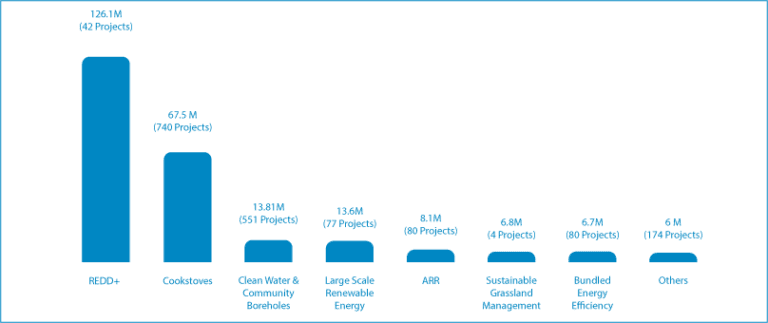
As the VCM market in Africa remains nascent relative to other regions, it is ACMI’s ambition to unlock US$6B in VCM revenue in Africa by 2030. Currently, most credits issued in Africa are from REDD+ (reducing emissions from deforestation and forest degradation), cookstoves, clean water and community boreholes, large scale renewable energy and ARR (afforestation, reforestation and revegetation).

Independent bodies

The global voluntary markets reached US$2B in 2022, primarily driven by Asia (US$765M) and Latin American and Caribbean (US$506M), followed by Africa (US$164M) and North America (US$136M). It is estimated that VCMs need to grow by more than 15 times by 2030. Globally, forestry and land uses’ carbon credits represent more than 40% (the majority) of all credits issued.

Key growth drivers of VCMs include the increasing number of corporate net zero commitments, increased government activity to engage with VCMs and the development of the enabling environment, namely independent standardisation bodies, such as the Voluntary Carbon Markets Integrity (VCMI).

Bianca Gichangi is the Regional Lead for Africa at the VCMI’s access strategy programme and explains how the VCMI’s Carbon Integrity Claims work: “These are claims for carbon credits that companies can make to demonstrate their climate achievement and meaningful climate action. Through these claims organisations acknowledge that they have gone above and beyond their science-aligned emission cuts to accelerate global net zero.”

She continues: “Companies can make these claims using our VCMI claims code of practice, which provides a universal standard for companies to, first of all, use carbon credits as part of their net zero transition, and second, to make verified claims about this use. This now ensures integrity on the demand side. And this means that companies use carbon credits in addition, not instead of, decarbonisation and make these credible claims.” [See full interview here.]

Here is a breakdown of carbon credits issued in Africa by project type: (Source: ACMI)
 Some successful carbon market projects in Africa include:

Nairobi carbon market auction: In June 2023, Nairobi, Kenya hosted the world’s largest carbon credit auction, selling over 2.2 million tons of carbon credits. The auction included projects like clean cookstoves in Kenya and Rwanda, and renewable energy projects in Egypt and South Africa.

Gabon: In October 2022, Gabon verified over 90 million tons of carbon credits under the UN-led REDD+ programme.

Durban landfill gas-to-electricity project: This World Bank project in South Africa added three megawatts of electricity to the Durban municipality and issued about 181,000 carbon credits.

Simoshi social enterprise in Uganda: This project installs cleaner cooking technology in schools, which has improved health and reduced firewood use.

Other countries in Africa with successful carbon market projects include Malawi, Mozambique, Togo, Nigeria, Burundi and Rwanda.

  • A masterclass on African carbon market opportunities will take place on 18 February, as part of the pre-conference of the upcoming Africa’s Green Economy Summit. This intensive, one-day training workshop will be presented by Andrew Gilder, Director at Climate Legal and Olivia Tuchten, Principal Climate Change Advisor at Promethium Carbon. Deepen your understanding of carbon finance, learn from practical examples and discover how to leverage carbon market opportunities to support sustainable development and climate action. Click here for more information and to book.

– This article first appeared in the GREEN ECONOMY EXPRESS, issued by Africa’s Green Economy Summit.

 

Will carbon credits and the private sector save Africa from climate change?

  Image: Freepik
Image: Freepik

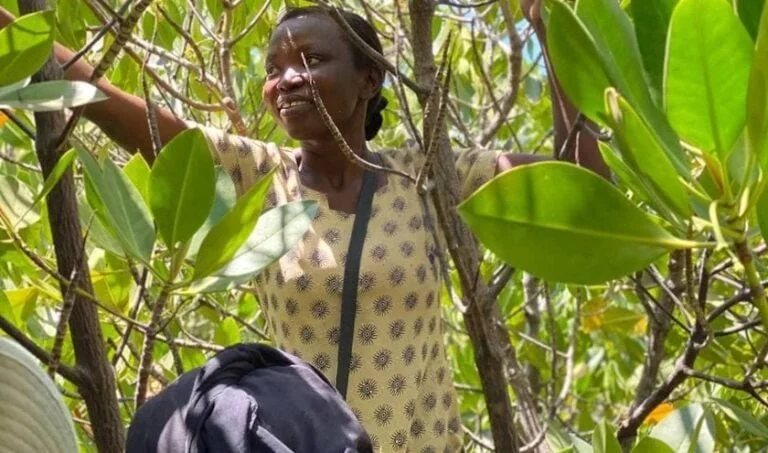
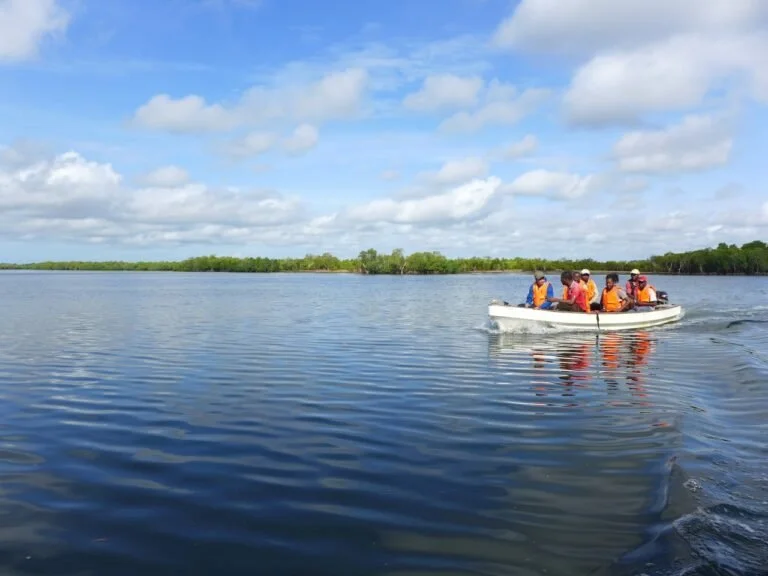
Robin Bartmann’s passion and enthusiasm for mangroves is palpable. “I am fascinated by mangroves,” he admits with a grin. Bartmann is the COO of Vlinder in Kenya, an organisation that restores mangroves to combat climate change, enhance biodiversity and empower communities through fair carbon sharing and sustainable livelihoods. The project is designed to plant 4.2 million mangrove trees, sequestering approximately 911,660 tCO2e over a 30-year crediting period, with potential extensions.

Vlinder (it means butterfly in Dutch) was one of nearly 60 investment-ready start-ups, projects and some multi-million dollar infrastructure developments looking for financial backing at the Investment Pitches at Africa’s Green Economy Summit (AGES) in Cape Town last week. The platforms connected high-impact projects with global investors, offering a dynamic platform to engage and foster real-world investment in Africa’s green economy.

The Papariko Mangrove Project in Kenya is one of Vlinder’s flagship initiatives aimed at restoring 1,500 hectares of degraded mangrove ecosystems across Kwale, Kilifi, and Tana River counties.

Pricing nature

Bartmann was also part of AGES’s Carbon Markets Masterclass, sharing key experience and insight into what it takes to successfully run a successful carbon credit project. “I was excited about the opportunity of pricing nature,” he explained, “83% of global carbon is in the ocean, and mangrove eco-systems remove carbon from the atmosphere at a rate 10 times greater and sequester 3–5 times more carbon than other forests.”

Important learnings in the Papariko project include the following: have at least two local partners and understand that land tenure and carbon rights are different things, understand how to get both. “Kenya is doing  a great job in developing the legislation around this,” stated Bartmann.


   Image: Vlinder
Image: Vlinder
   Image: Vlinder
Image: Vlinder

Gender empowerment is very important in this project said Bartmann: “Women are central to the solution; they are taking leadership roles in managing and implementing the project.” They are using blended finance, and 45% of their carbon credits entail carbon forward contracts. The risks of a mangrove project like Papariko include conflicts over land rights, fluctuating carbon prices, policy changes, extreme weather and pests or diseases.

On Day 2 of the event, the session on sustainable agri practices also featured some fascinating examples of successful, nature-based sustainable agricultural solutions. [Click here for the highlights of AGES Day 2.]

Fundamentally different

“There are real opportunities in this sector. But many clients think they can do spectacularly well. But if you are going to embark in these kinds of opportunities, you need to upskill yourself,” said  Olivia Tuchten, Principal Climate Change Advisor at Promethium Carbon and one of the masterclass facilitators. “Perhaps business models need to be looked at differently. Project developers need to know that the returns are different than from, for example, mines. This is not mining or retail, it is fundamentally different, although there is money to be made and good stuff to be achieved.”

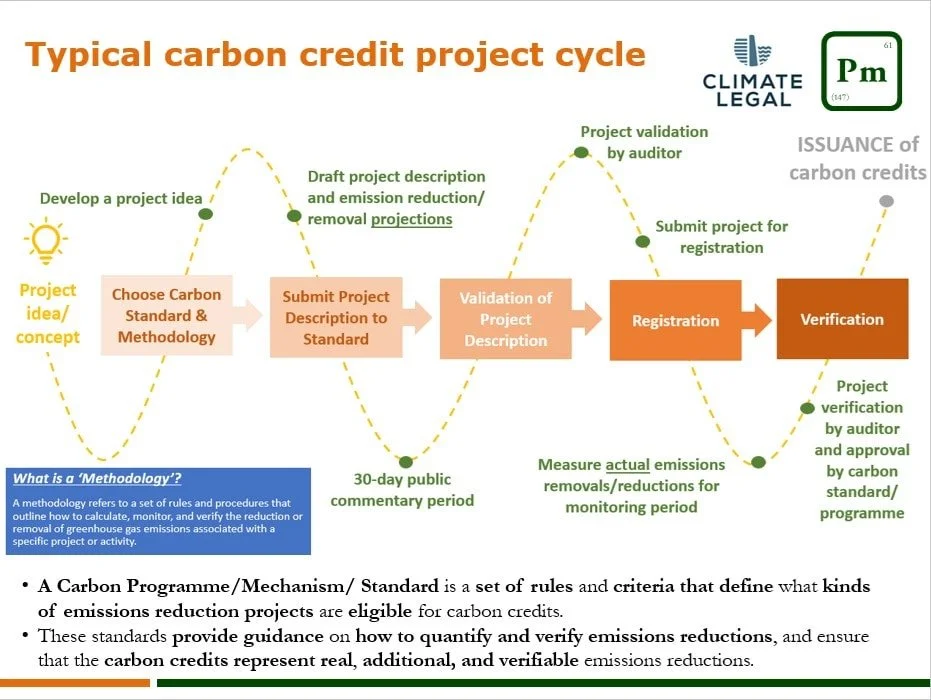
Tuchten took the masterclass attendees through a detailed roadmap of how to apply and qualify for carbon credits: “Many companies often underestimate the audit process. There are many steps needed to assure integrity, and increasingly there is a proliferation of niche carbon standards.” Particularly, she explained that “additionality” has to be demonstrated. This means that the emission reductions must be additional to what would have happened without the project ad that the project should go beyond business-as-usual activities.

   Image: AGES Carbon Markets Masterclass
Image: AGES Carbon Markets Masterclass

We need to do things differently

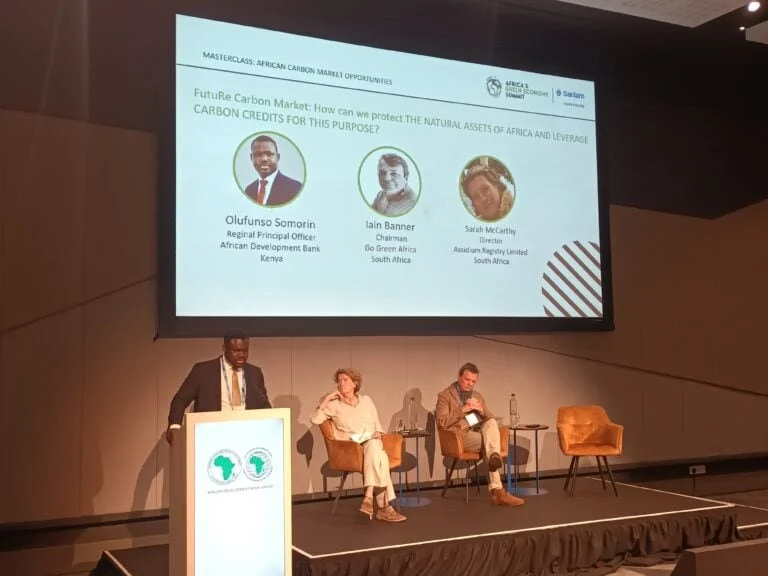
“Nothing compares to the private sector or a market-led approach to climate mitigation,” said Olufunso Somorin, Regional Principal Officer at the African Development Bank (AfDB) in a session on leveraging carbon credits. “However, Africa is still not maximising its potential. We need to do things differently. One of the challenges is that there are many good project developers who have very good ideas, but they don’t have the resources to jumpstart their idea into an investable project.” He reminded the audience that only 17 project developers are largely responsible for most of the carbon projects on the continent.

Somorin announced: “The AfDB is creating the African Carbon Support Facility (ACSF), and we are hoping to start off with a $100 million capitalisation.” Among the goals are supporting countries towards market-creating policy shifts, and the bulk of the funds will provide resources to project developers and assist in validation costs. “The AfDB wants to be able to increase the number of African-owned, African-based and African-led project developments on the ground,” he added.

Where is the private sector?

Common themes during AGES were discussions about derisking not only Africa as an investment destination but also climate finance for the continent, particularly for a sceptical and careful private sector.

During the opening keynote session, Barbara Buchner, Global Managing Director of the Climate Policy Initiative noted that current climate finance covered less than a quarter of what is needed on the continent due to high perceived risk and a lack of bankable projects, adding that only 18% of the money comes from the private sector.

However, on a more hopeful note, during the keynote on the following day, finance giant Sanlam Investments’ CEO Carl Roothman reminded attendees that the current economic climate, which sees so many governments and businesses focus on climate change and green finance, presents a once-in-a-lifetime opportunity for Africa. The company is active in 27 countries on the continent.

“I don’t think you will see in another 150 years the opportunity for access to the global capital and enthusiasm from the rest of the world, to invest in Africa” said Roothman. This enthusiasm, though, does create a responsibility for everyone in Africa, he admonished. Read more.

This is a nascent sector

“Africa has a huge opportunity to monetise the eco-system services that are natural capital systems, but it has got to be bankable” is how Standard Bank’s Lawrence Cole-Morgan, Global Markets: Lead, Carbon Credit Trading explained the careful stance of many banks.

He added that eco-system services such as the Congo basin and biodiversity services are services to the planet that can be monetised. “These natural systems are like infrastructure that we rely on as societies to exist, but as commercial banks we have to do it this within our lane. What we are seeking to do is see how we can fund the upstream production of carbon credits that are a monetisable commodity, a monetisable eco-system service, and fund against them; very much looking like project finance.”

“We are staying in our lane,” he continued, “managing our risks, either through blended finance, insurance or other market mechanisms.” Cole-Morgan added: “This is a nascent sector. If you look back 15 years ago, as banks we were all looking at the renewable sector in the same way. [ ] We learned how to derisk.”

Long-term perspective

“When it comes to developing such projects, it takes a lot of engineering effort to really derisk a project,” said project developer Leon Van Wyk, who is the CEO of Lesedi, a leading African EPCM. He continued: “There is a lot of work to be done between the development stream and the investing stream where the bank needs to provide its ultimate approval. In addition, projects tend to be developed in isolation, and when you look at how many renewable projects are being developed, there is not a lot of regard for grid stability, which needs to be dealt with. Our interconnectivity and grid resilience are not the same as in European markets.”

In addition, van Wyk expressed concern about the short-term nature of many projects seeking carbon credits to off-set their carbon footprint: “It is a quick fix for whatever the problem is that they are facing. And that is not necessarily the right approach in terms of how we solve decarbonisation from a long-term perspective.”

Mixed feelings: data lacking

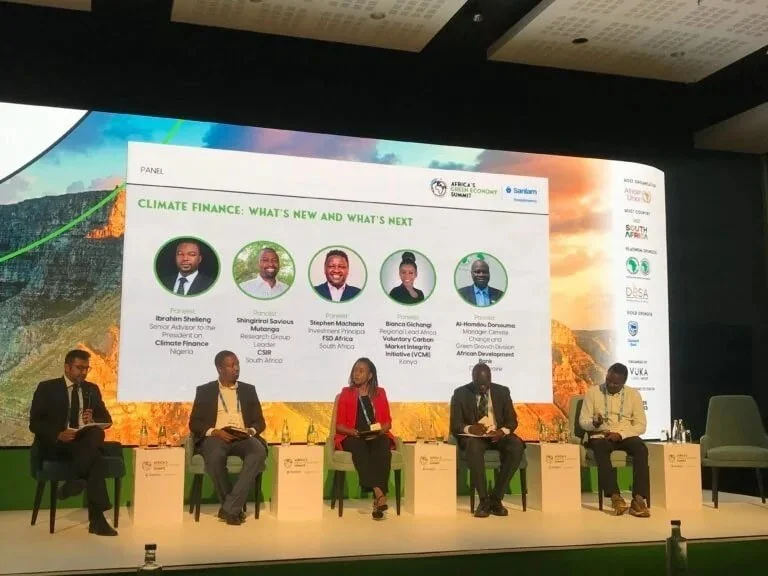
During question time in a panel discussion on “What is new and what’s next in climate finance?” former World Bank sustainability guru Dr John Roome challenged the experts on what he had heard thus far: “I have very mixed feelings. Will this radically change getting private sector into climate finance? Is this the best we can do?” He asked the panel to name the one thing that they think might make the difference. The panel agreed that the lack of big data in the African climate space was a major gap.

“Very little is invested in data, and countries are unable to account for what they have,” said Shingirirai Savious Mutanga, CSIR research group leader, adding: “for me the answer is data. Then we will have the evidence that we need and won’t struggle to build a pipeline.”

Bianca Gichangi, Regional Lead – Africa at Voluntary Carbon Market Integrity Initiative (VCMI) concurred: “Big data has enabled us to make great strides. We need to prioritise it in the $1.3 trillion that is needed.”

For more AGES highlights:
Pre-con day
Day 1
Day 2

  • This article first appeared in the Green Economy Express newsletter, published by Africa’s Green Economy Summit.