
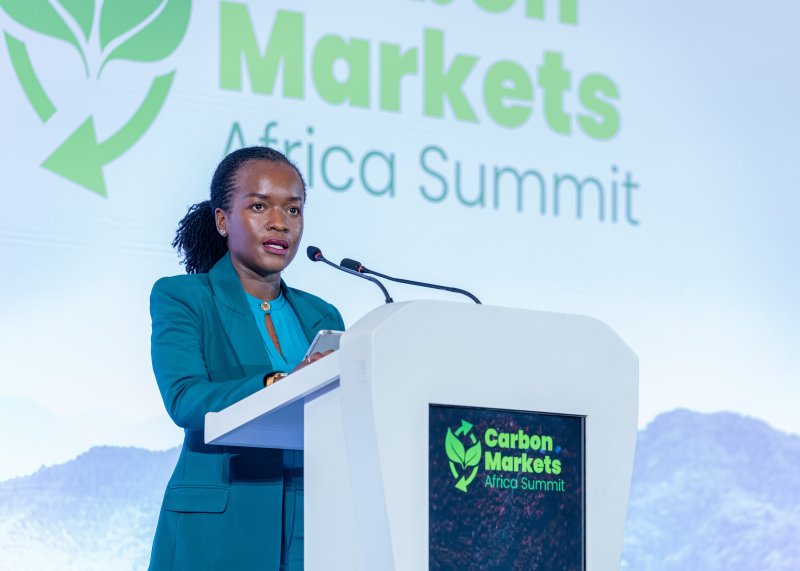
Improved cookstove projects account for about 87% of Rwanda’s issued carbon credits, Environment Minister Dr. Bernadette Arakwiye said on Wednesday, October 14, as she called for the country to expand carbon finance into other sectors, including agriculture, renewable energy and electric mobility.
Speaking at the Carbon Markets Africa Summit in Kigali, Arakwiye said Rwanda had made progress in registering projects but needed to widen the range of activities capable of attracting investment and generating verified emissions reductions.
The 87% figure appears in Rwanda’s official carbon market data based on credits issued through December 2020. It should therefore be treated as a historical measure, not a new breakdown of the market in 2026.

“This is an achievement worth recognizing, but it also tells us something important, that our markets remain too concentrated in interventions that are easier to measure, easier to finance, and easier to sell,” she said.
Rwanda has registered 29 carbon market projects covering forestry, agriculture, land conservation, electric mobility, waste management and renewable energy. Registration alone, however, does not mean a project has secured financing, generated verified credits or completed a sale.
Arakwiye called for greater investment in renewable energy, sustainable waste management, industrial decarbonisation and nature-based solutions. She also pointed to agriculture’s potential to contribute to emissions reductions, despite the difficulties many agricultural projects face in accessing carbon finance.
Early-stage funding remains a barrier
The minister identified three challenges facing Rwanda’s carbon market: promising initiatives that have not been structured for carbon finance, limited technical expertise to assess project viability and monitoring requirements, and projects that cannot proceed because they lack early-stage funding.
Before attracting investors, projects may need to pay for feasibility studies, baseline measurements, validation and systems to monitor and verify emissions reductions. These costs can be difficult to meet before a project begins generating revenue.
Arakwiye called for methodologies suited to African conditions, dedicated facilities to prepare projects for investment and stronger long-term demand for high-quality credits.
She also urged buyers to offer fair prices, longer-term purchase agreements and patient capital, saying uncertain demand and short contracts can make it difficult for projects to plan and secure financing.
Rwanda is exploring a proposal to channel part of the proceeds from carbon transactions through the Rwanda Green Fund to support the preparation and pre-financing of new projects. Arakwiye announced the idea at the summit but did not disclose a funding allocation, an implementation date or details of an approved programme.
Communities and verification
Arakwiye said expansion must be accompanied by transparent transactions, credible verification and fair arrangements for sharing revenue with communities involved in projects using their land or natural resources.
“Benefits cannot be fairly shared from revenues that cannot be seen,” she said, calling for disclosure that shows how much money reaches communities and how funds are reinvested.
Carbon credits represent verified reductions or removals of greenhouse gas emissions. Their credibility depends on reliable measurement and verification, while international transfers under Article 6 of the Paris Agreement require careful accounting to avoid double counting.

The minister urged African governments to coordinate their approaches where possible while protecting national development priorities. She also called on international partners to invest in local institutions, technical expertise and data systems rather than treating Africa only as a supplier of credits.
The Carbon Markets Africa Summit is being held in Kigali from October 13 to 15, bringing together government representatives, investors, buyers and project developers to discuss how African carbon markets can attract investment and deliver credible climate benefits.